The animal
The Bactrian camel: the animal that carried the Silk Road
Two humps, thick winter wool and a talent for cold and dryness: what Wikipedia says about the camel behind the caravans, and why one belongs on a Silk Road stage.
Pick my zone ↗Quick answer
The Bactrian camel is the two-humped camel of the Central Asian steppes. Wikipedia says its tolerance for cold, drought and high altitude enabled caravans on the Silk Road. That makes it the natural animal for a Silk Road show, and the reason reviewers' mentions of live camels fit the theme.
Bactrian camel and dromedary compared
| Bactrian camel | Dromedary | |
|---|---|---|
| Humps | Two | One |
| Native range | Steppes of Central Asia | Probably evolved in the hotter, arid regions of western Asia |
| Silk Road link | Enabled caravans through cold, drought and high altitude | Hybrids with the Bactrian were bred and can bear greater loads |
| Name | From the ancient region of Bactria | From the Greek word for runner |
Two humps, one species
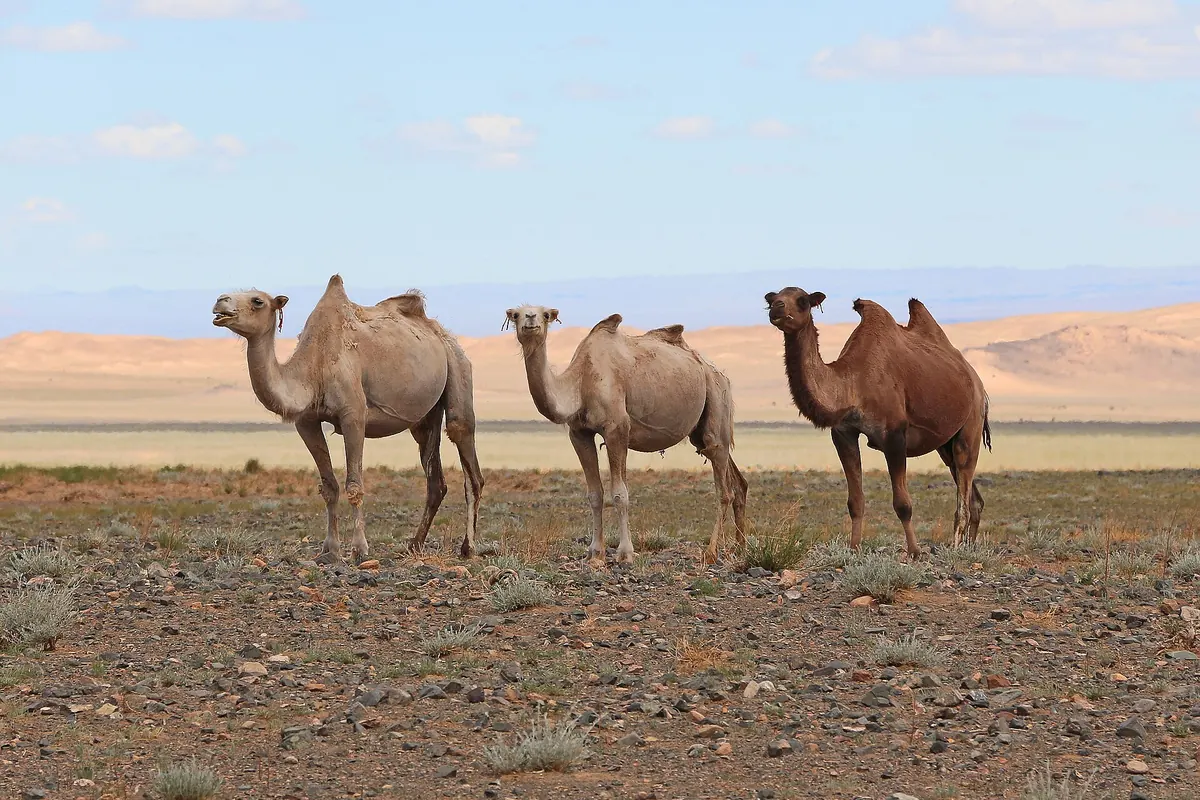
The Bactrian camel, Camelus bactrianus, is the two-humped camel, native to the steppes of Central Asia. Wikipedia gives its population as about two million, almost all of it domesticated, and notes that its name comes from the ancient region of Bactria. It is a separate species from the wild Bactrian camel, and the domestic animal does not descend from the wild one, since the two lines split around a million years ago. The Greek philosopher Aristotle was the first European to describe camels, and in the fourth century BCE he distinguished the one-humped Arabian camel from the two-humped Bactrian. For a visitor, the simplest test is still the humps: two means Bactrian, and that is the camel of the Silk Road caravans.
Built for cold and dust
Wikipedia describes the animal as the largest mammal in its native range. Shoulder height runs from 160 to 180 centimetres, and body mass can range from 300 to 1,000 kilograms. The long woolly coat varies from dark brown to sandy beige, and a shaggy winter coat is shed in large patches. The two humps are made of fat, not of water, as many people assume. Long eyelashes and sealable nostrils help keep out dust in sandstorms. The broad two-toed feet spread wide to cope with sand. The coat can withstand temperatures as low as minus 30 degrees Celsius in winter and heat up to 50 degrees in summer. Habitats range from mountain massifs to the Gobi, which is exactly the variety a long caravan route demanded of its animals.
Why the caravans needed it
A pack animal on the Silk Road had to cross deserts, plateaus and mountain passes where water was scarce and the weather was extreme. Wikipedia says the domesticated Bactrian camel has served as a pack animal in inner Asia since ancient times and that its tolerance for cold, drought and high altitude enabled the travel of caravans on the Silk Road. Elsewhere in the same article it records that these camels can carry loads of 170 kilograms at more than 5,200 metres, much more than the ponies in use there. Another Wikipedia article adds that camels were among the western exports on the Silk Road. Wikipedia's article on caravanserais adds that these roadside inns, which supported commerce along the Silk Road, often had space for camels and other pack animals alongside the lodging for people. The practical lesson is that the animal was less an ornament than a piece of infrastructure, which explains why camels show up repeatedly in the story of the trade.
Camels in Tang art
Camels are not only in the history books. Wikimedia Commons holds photographs of glazed Tang-style camel figures in museum cases, including figure groups with musicians sitting on the animal's back. They are a reminder that Tang audiences knew the animal as a living sign of distant travel, and Wikipedia notes that songs, dances and musical instruments from foreign regions became popular in China during the Tang dynasty. A stage show about the Silk Road that includes live camels is working in a long visual tradition. The booking page does not describe the animals, so this guide does not either, but reviewers mention live camels and trained wolves on stage. If the animals matter to your decision, read the most recent reviews for what travellers saw.
Seeing camels responsibly
Visitors who care about animal welfare often want a few questions answered before they book a show with live animals. The booking page does not provide answers on housing, rest or handling, so this guide cannot either. What it can say is where to ask: put your questions to the seller through GetYourGuide before you pay, and read recent reviews for any comment on how the animals were handled. If you would rather avoid live animals on a stage altogether, that is a reasonable decision, and the Terracotta Army tour in the comparison guide is a daytime alternative without animals. The point of this guide is to give you enough about the camel itself to make a decision that suits you, whichever way it goes.
Frequently asked questions
How can I tell a Bactrian camel from a dromedary?
By the humps: the Bactrian camel has two and the dromedary has one, according to Wikipedia.
Are camel humps full of water?
No. Wikipedia says the two humps are composed of fat, not water.
Does the show use real camels?
Reviewers on the booking page mention live camels and trained wolves on stage. The listing does not describe the animals.
Sources