The road
Chang'an: the city where the Silk Road began
How Xi'an, once called Chang'an, became the eastern end of the overland Silk Road: the envoy who opened the way west, the Sogdian merchants who carried the trade and the Tang capital at its height.
Pick my zone ↗Quick answer
Xi'an was called Chang'an for much of its history and Wikipedia describes it as the cosmopolitan eastern terminus of the overland Silk Road. The road grew out of the Han dynasty's push into Central Asia around 114 BCE, through the missions of the envoy Zhang Qian, and peaked under the Tang, when Chang'an was among the largest cities in the world.
From Han envoy to Tang capital
| Moment | What Wikipedia records |
|---|---|
| Capital of dynasties | Chang'an was capital of several dynasties, including the Western Han and the Tang, from 202 BC to 907 AD |
| Zhang Qian | Sent west in 138 BC as an imperial envoy of the Han |
| Network | The Silk Road network began with Han expansion into Central Asia around 114 BCE |
| Tang size | Modern estimates put the Tang city's walled population at around 800,000 to 1,000,000 |
| UNESCO | The Chang'an-Tianshan corridor was designated a World Heritage Site in 2014 |
A capital with many names
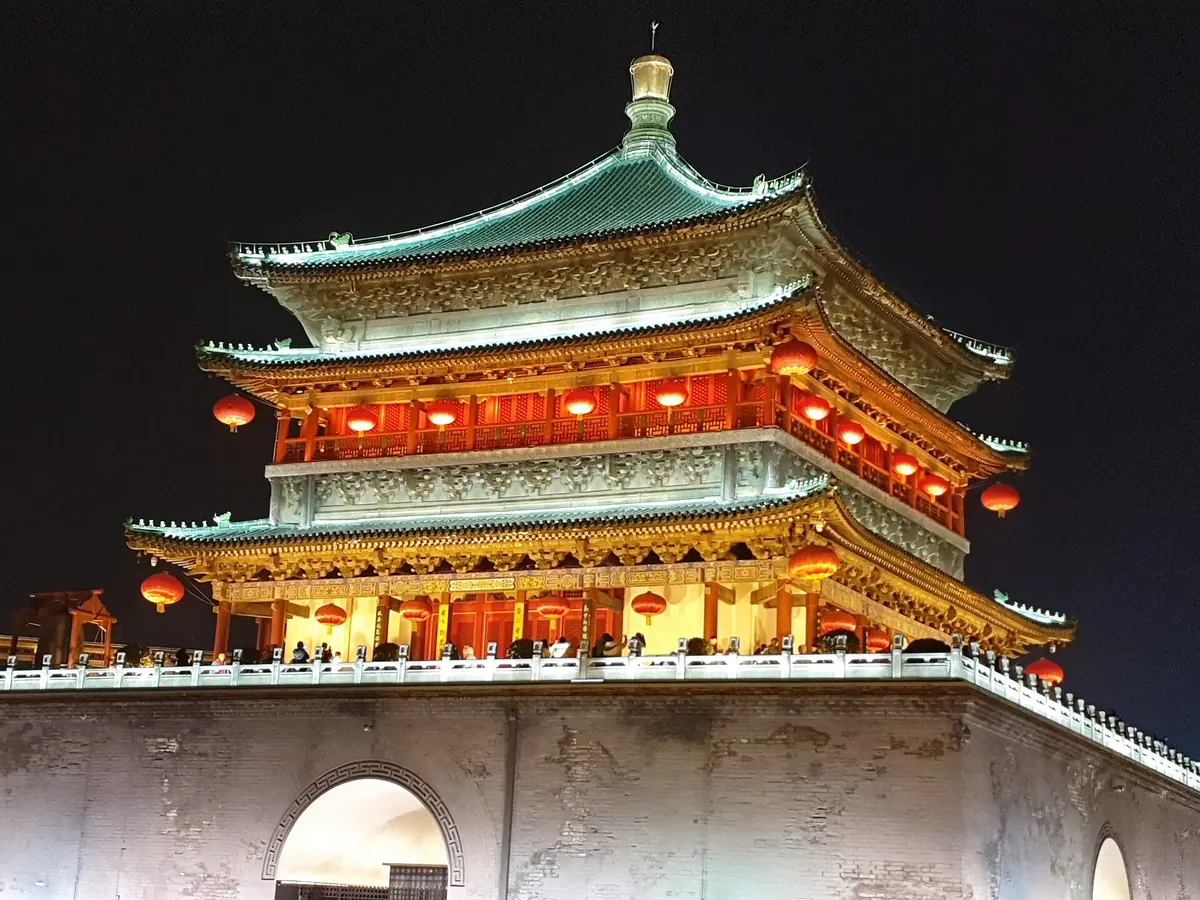
Today's Xi'an took that name in 1369 under the early Ming dynasty. For most of its earlier history it was Chang'an, a name that means perpetual peace, and under that name it was the capital of several dynasties. Wikipedia lists the Western Zhou, Qin, Western Han, Sui, Northern Zhou and Tang among the dynasties that held court in the area, and says Chang'an itself served from 202 BC to 907 AD. Wikipedia's article on the city calls it the political, economic and cultural centre of China as well as the cosmopolitan eastern terminus of the overland Silk Road. That is a strong claim, so it matters that it is attributed: it is a summary of the scholarship, not a figure measured on a wall. The effect for a visitor is the same either way. When a show or a guide says the Silk Road began in Xi'an, there is a respectable source behind the line.
The envoy who opened the road west
According to Wikipedia, Zhang Qian was a Chinese diplomat and explorer who served as an imperial envoy in the late second century BC under the Western Han. He entered Chang'an between 140 and 134 BC as a gentleman in the service of Emperor Wu, and was dispatched to the Western Regions in 138 BC with a party of ninety-nine to seek an alliance against the Xiongnu, who controlled much of the lands to the northwest. The Silk Road article credits his missions with expanding the Central Asian parts of the routes around 114 BCE, which is also the date Wikipedia gives for the network's beginning as the Han dynasty brought the region under unified control. The road, in other words, did not appear as a trade route first. It began as diplomacy and security, and commerce followed the political connection.
Silk, camels and the goods that moved
The name Silk Road comes from the lucrative trade in silk textiles that were mainly made in China, and it was popularised in 1877 by the German geographer Ferdinand von Richthofen. Wikipedia notes that some historians prefer the plural, Silk Routes, because the system was a web of land and sea routes, not a single road. By the first century CE Chinese silk was widely sought in Rome, Egypt and Greece. Wikipedia says caravans on the northern route sent back bolts of silk brocade, lacquer-ware and porcelain in exchange for goods such as dates, saffron, glass bottles and sandalwood, and lists horses, camels, honey, wine and gold among the western exports. Camels are on that list because they were both cargo and carriers. The Bactrian camel, in Wikipedia's account, enabled caravans on the Silk Road through its tolerance for cold, drought and high altitude, which is why a story about the Silk Road is hard to tell without one.
The Sogdians: the middlemen of the road
Few merchants travelled the whole road. Wikipedia says most did not, but traded goods through middlemen based in oasis towns such as Khotan or Dunhuang. The Sogdians, an Iranian-speaking people from Central Asia, played an essential role as middlemen, and Sogdian served as a lingua franca in Central Asia. Sogdians also lived in imperial China and rose to prominence in the military and government of the Tang. Two Sogdian tombs were found in Xi'an in the early 2000s, and Wikipedia says they were the first Sogdian tombs discovered that had never been opened before archaeologists reached them. The tomb of An Jia, found in 2001, mixed Chinese and Sogdian burial practices. These finds are evidence that the people of the Silk Road lived in Chang'an, not just passed through it.
Tang Chang'an at its height
Wikipedia calls the Tang a high point of Chinese civilisation and a golden age of cosmopolitan culture, and says the capital at Chang'an was the world's most populous city for much of the dynasty. Around 750 AD Chinese records called it a million-man city. Most modern estimates put the walled Tang city at roughly 800,000 to 1,000,000 people, and the 742 AD census recorded about 1.96 million in the wider Jingzhao province. The city had two great walled marketplaces, the East Market and the West Market, each laid out in nine blocks, and the Nine Markets are described as the eastern economic terminus of the Silk Road. These details matter for a visitor because they show what the stage is trying to evoke: a capital where foreign merchants, monks, musicians and court administrators met, with trade in the middle of it.
Reading the city today
Little of Tang Chang'an stands above ground, and the walls that visitors walk today are not Tang. Wikipedia says the Ming dynasty built the city wall, starting in 1370, over an existing Tang palace wall, around the former Sui and Tang palace district, an area about an eighth the size of the medieval city at its height. The Giant Wild Goose Pagoda, first built in 652, is a Tang survivor in a rebuilt form. The UNESCO corridor listing of 2014 includes component sites in Xi'an. Together they give a modest but real trail of evidence. A Silk Road show on a Xi'an stage is therefore best seen as an invitation to look at those places afterwards, and the guide on Tang culture says where to start.
Frequently asked questions
Was Chang'an really the end of the Silk Road?
Wikipedia describes Chang'an as the eastern terminus of the overland Silk Road, while noting that some scholars prefer to speak of Silk Routes, a web of routes, instead of one road.
Who was Zhang Qian?
A Han dynasty envoy sent west in 138 BC. Wikipedia credits his missions with expanding the Central Asian parts of the Silk Road around 114 BCE.
Who were the Sogdians?
An Iranian-speaking people from Central Asia who acted as middlemen on the Silk Road and lived in Tang China.
Sources